
MOBVEC Project
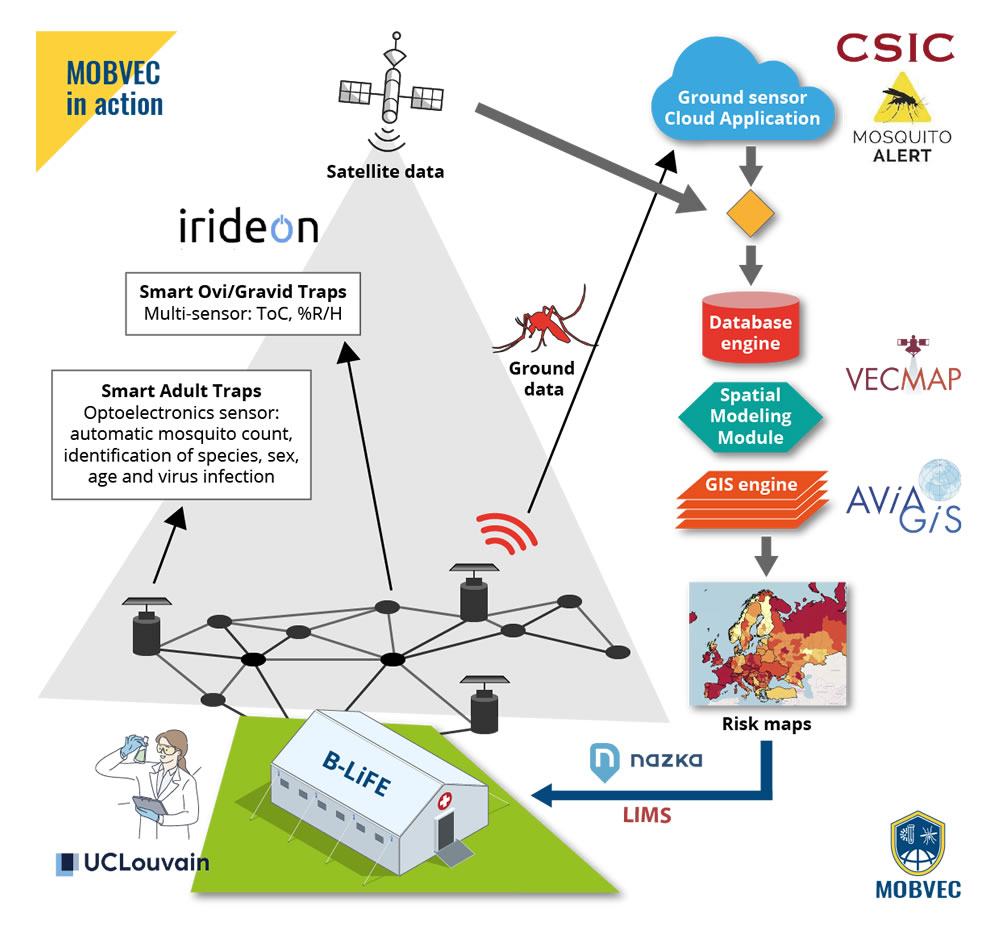
The aim of the MOBVEC project is to create first VBD Mobile Bio-Lab in the world, providing a global service based on the five pillar points depicted below
MOBVEC will be the first VBD Mobile Bio-Lab in the world, providing a global service
( 1 )
Automatic information about vector populations and environment, obtained in real-time by smart-traps, powered by machine-learning and edge computing: insect species, sex, age, and viral infection
( 2 )
GEOSS compliant vector risk maps of adult insects and eggs/larvae, built on field + Copernicus data
( 3 )
GEOSS compliant disease transmission models in mosquito population, fusing data provided by a) Copernicus, b) clinical and diagnostic data of reference labs, and c) vector risk maps
( 4 )
GEOSS compliant citizen-science platform to reinforce the surveillance of mosquitoes using citizens as observation nodes, whose data is automatically calibrated using the data from smart traps
( 5 )
VBD mobile bio-lab with the capacities of points 1, 2 and 3 + VBD Epidemiological maps, forecast models, and molecular analysis of arboviruses, to be rapidly operational in the heart of VBD outbreaks to assist first-responders

Development of the bio-laboratory protocols with biological samples
- Protocol to test new smart traps with different species of disease-carrying mosquitoes
- Breeding of mosquito specimens of different species for laboratory tests
- Field collection of specimens at immature stages (eggs, larvae or pupae) using INSA`s mosquito control program
- Implementation of new on-site tests for viral detection: NGS (next generation sequencing)
- Development of an optimized method for the conservation and transport of viral RNAs
- Development of protocol for deployment of ground sensors with deployable bio-lab in case of outbreaks
- Development of protocol of deployable bio-lab to work with local health authorities in VBD outbreak scenarios

Development of VBD EO models using EGNSS, COPERNICUS and GEOSS
- Implementation of Sentinel 3A products to obtain vegetation and temperature data
- Implementation of ESA`s SNAP framework to save time and money and our MODIS processing chain
- Implementation of other Copernicus Global Land Service products for vegetation (e.g. Proba-V derived products)
- Implementation of algorithms to correct sources of error (e.g. clouds) and obtain seasonal components of data
- Benchmarking to the existing data sets (like MODIS) performed at different stages of the processing chain
- Fourier outputs will be compared and influence of the different products on the model accuracy will be verified
- Development of Vector Risk Maps and SDSS with real-time field data from EGNSS supported ground sensors
- Find the best synergy between the amount of ground sensors (field traps) and the EO data driven models
- Development of VBD Transmission Models with fusion of Vector Risk Maps with virus diagnostic data
- Development of Epidemiological Risk Maps and Models

Advanced design of IoT ground sensors
- Ground sensors designed to form a wireless sensor network, with adult smart traps as a gateway, surrounded by smart ovitraps as multi-sensor nodes that capture gravid female/egg laying activity and micro-environmental data
- IoT sensor designed for minimal maintenance and low-power consumption, with solar power capacity
- Optimize optoelectronics to capture spectral characteristics of wing-beat (fundamental and harmonic frequencies) with miniaturized versions of original prototype, and improvement of signal to noise ratio
- Optimize machine learning classification models for different species and different variables as viral infection
- Test response of smart traps to mixtures of autochthonous and invasive mosquito species, sharing the same habitat
- Test communications of multi-sensor nodes with gateway and cloud server
- Design of communication framework accounting reliability, lifetime and existing infrastructures
- WSN based on LoWPAN or LPWAN to provide low-power, low-cost and reduced data rate wireless transmissions

Development of a standards based interoperable machine-learning cloud application
- Integrated software developed as part of a cloud server application for handling field data to support the end-users
- Input data processor and storage module to automatically process geospatial data transferred from field nodes
- Multi-accessible database with historical logging, user details, and environmental & infestation data
- Reach full interoperability between servers of ground sensors, Vector and VBD EO systems
- Performs calculations based on the data collected from traps, and issues alerts (e.g. risk of infestation in a region)
- Interactive system to enable the end-user to register the control methods implemented in a given area
- SDSS to gather data and compile statistical information to reduce costs in pest control and evaluate effectiveness
- Graphical user interface designed to be easily and intuitively used in multi platforms
- Processed data INSPIRE compliant to ensure full interoperability

Integration and field trials and pilots of the MOBVEC prototype system
- Test smart trap gateway and multi-sensor nodes to validate field operational performance
- Ground sensor WSN system trialed and piloted under actual field conditions in real surveillance programmes
- IoT sensor reaches >70% accuracy detecting and classifying mosquito species, age, and viral infection
- EO models with accuracy of an Area Under the Curve of 0.8 and a sensitivity and specificity of 0.7
- Test of communications of field data to cloud servers
- Validation of Vector Risk Maps and Citizen Science platform in real vector surveillance programmes
- Validation of VBD-Vector-Borne Diseases Transmission Models, and Epidemiological Risk Maps/Models based on COPERNICUS data with historical data of previous outbreaks
- Validation of the deployment of mobile bio-lab in a simulation of outbreak with health authorities
- Validation of the whole MOBVEC system under REVIVE and national communication protocols of communicable diseases with the European
Epidemiological Surveillance Program (TESSy) of the ECDC - Validation of the whole MOBVEC system under a scenario of a real VBD outbreak in the EU (contact with French and Italian Health
authorities in regions where VBD outbreaks occur each year)

Pathway for future delivery MOBVEC onto the market and into society
- Reassessment of market, recent opportunities/developments, trends and share
- Perform a customer development study with feedback from end-users, and a risk analysis of market fit
- Analysis of bottlenecks following identified market segments and perform a business ecosystem analysis
- Perform a market demonstration of the system and assess the performance and level of user satisfaction
- Promote market replication engaging end-users and potential clients and providing training workshops
- Implement a knowledge management and IP protection strategy, for the international exploitation of the technology
Contact Us
info@mobvec.eu
Follow us in Linkedin

Mobile Bio-Lab to support first response in Arbovirus outbreaks (MOBVEC) Is funded within a European Union’s Horizon Europe research and innovation programme under Grant Agreement № 101099283